‘The Stormrider’

(See also ‘The Nameless One”)

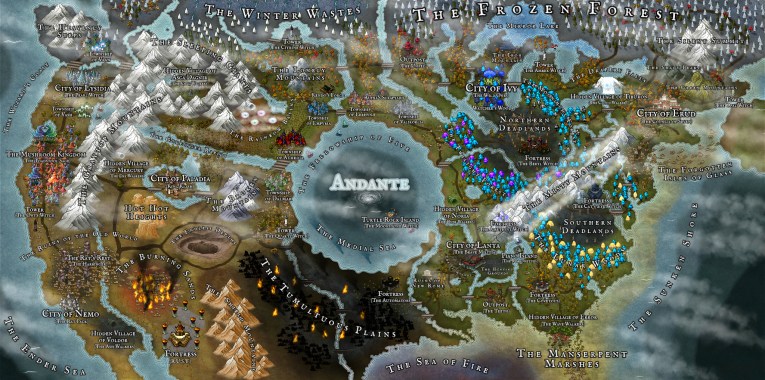
Throughout the City of Lanta, local folklore tells of the Stormrider, a mythical figure that rides a great, nameless Black Dragon, forever stirring the clouds of the Tumultuous Plains until they boil over and become violent storms capable of rending the earth with their fury. As the legend goes, the dragon covets the Silver Moonflowers, but alas, none of them grow upon his lands, for nothing can share a home with those calamitous storms. When one of those twisting maelstroms from the Tumultuous Plains breaks free and travels east, towards the mountain, it is supposedly the Nameless One hunting for the elusive Silver Moonflowers.

The legend of the Stormrider begins with a brazen young boy who took it upon himself to bring the dragon that which it coveted. As the story goes, the Nameless One wasted no time finding the boy upon the edge of the plains. As the sky grew dark around him, the sun faded away. When he presented the Silver Moonflower to the sky above, both the boy and the flower were swept away, engulfed by a sudden storm, and yet unharmed. The nameless dragon, an intelligent but lonely creature, decided that it would bestow its wisdom and power upon the boy, and so the boy became something apart from the human race entirely.

A commonly held superstition around the City of Lanta is that the Stormrider himself will appear before the wicked as a wild-eyed, long-haired teenage boy on stormy nights, warning them of the consequences of their continued actions. The superstition continues, positing that those who ignore the warning will be visited by the Nameless One and put to death by the great black dragon, or one of its mighty storms.
‘Silver Moonflower’

A rare and delicate beauty. Do not confuse this with your run of the mill Moonflower. Your typical Moonflower is white and can be found in various places throughout the Emerald Ring. Unlike most flowers, they bloom at night. This, along with their petal shape, size, and number, are the only things the common Moonflower shares with its cousin, the Silver Moonflower.

True to its name, the Silver Moonflower is not white, but a lustrous silver that sparkles even in the darkness, where it grows. These rare beauties can only be found in the deepest parts of the Lunar Woods, where the canopy is the thickest and the forest is at its darkest. It is only here, on moonless nights, may one find an elusive Silver Moonflower.

Even if you were so lucky as to find such a treasure, you must take care when handling it. First, the flower cannot be wrested from the earth, even by a delicate hand. It must be cut at the stem, just above the soil, by a sharp, swift blade made out of silver. If successfully extracted from the earth, great care must be taken to avoid letting any daylight touch the flower. It should be transported in a dark, secure container, if possible. If any sunlight should fall upon a Silver Moonflower, it shall wilt and die in a matter of seconds, and this is why they are so difficult to find and highly sought after by collectors.

There are two legends about the Silver Moonflower that are prominently known throughout the Eastern Wilds. In addition, throughout the City of Lanta, the Silver Moonflower is feared as a bringer of disaster.

The first myth tells us of the Nameless One, a great black dragon that stirs the clouds of the Tumultuous Plains with its massive wings. Supposedly, this dragon covets the Silver Moonflowers, which can only be found far to the east of its home. When one of the wild storms from the Tumultuous Plains breaks free and travels east, towards the mountain, it is supposedly the Nameless One hunting for Silver Moonflowers.

The second, related myth where the Silver Moonflower makes an appearance is the legend of the Stormrider, which involves a brazen young boy who took it upon himself to bring the dragon the flower which it coveted. As the tale is told, the dragon recognized the boy for his courage and decided to bless him with a portion of its power, birthing the Stormrider, a mythical figure that appears before the wicked and warn them to change their ways.

‘Black Orchids’

The Black Orchids are a beautiful but deadly species of fauna known to grow in the Eastern Ring. More specifically, these tend to be found around the Misty Mountains. These flowers are rare to find in great numbers, as they have excellent medicinal properties. Harvesting the Black Orchids is not without its pitfalls, though. They must be handled with care, as their pollen is an intoxicant able to put even sizeable animals to sleep in a matter of minutes. This special property is the reason the flowers are sought out in the first place – they are a primitive, yet effective anesthetic.

There is one place where the Black Orchid can be found en masse. This location is known as the Wall of Sleep, a huge construction of stone encircling the fortress atop Blue Mountain. Here the Black Orchids grow in great abundance around the wall. Many who have ventured to visit the Wall of Sleep have disappeared, never to be found. The fortress protected by the Wall of Sleep is rumored to be the home of a powerful witch, but no one has ever managed to confirm this.

‘Sentry Owls’

Horned Owls are a fierce predator known to hunt in the forests at night time. Their relative, Sentry Owls, are known to do the same, although there is a noticeable size difference between the two. By most estimates, the Sentry Owl’s wingspan can reach up to four paces across whereas a Horned Owl would top out around two paces. The Sentry Owl’s talons are incredibly sharp and durable, capable of rending flesh, muscle, and ligaments alike. Their beaks are powerful enough to pry apart its meals with ease. These owls, like their relatives, hunt exclusively at night time and they have developed huge, almost comical-looking eyes that are adept at seeing in the dark.

The Sentry Owl is known to eat a variety of small woodland creatures. They can take down foxes, dogs, even small wolves without any issue. They typically do not attack humans unless they feel threatened, but if you are traveling through the woods with small children or animals, you had best take caution. Although these owls don’t typically hunt during the day, some can and will break the mold if they get hungry enough.

The Sentry Owl does not have many natural predators, but among its most feared is the Hunter Spider. These spiders just as big as a Sentry Owl, but they are much heavier and are more than capable of leaping great heights to take down a Sentry Owl. That said, the Sentry Owl’s natural defenses are more than enough to turn the tables, depending on the situation. To protect their young, the Sentry Owl will typically not nest in forests, but instead look to find an isolated tree in the countryside instead. Fiercely territorial, the Sentry Owl will remove (and kill) any birds that are currently trying to nest in its desired tree.

‘Mirwolves’

“Have you ever seen a wolf stand next to a dog? You might think there’s not much of a different in size if you’ve never seen the two standing side by side. Granted, this depends on the breed of the dog, but typically, a wolf is about twice the size of your average dog. So what is a Mirwolf? Well, if you put a Mirwolf next to a regular wolf, you’d see the same kinda difference. A full grown wolf might weigh up to ten stone, but a Mirwolf can top out closer to twenty stone, making them larger than many people.

Mirwolves are a proud beast that roam all of the lands north of the Median Sea. They are not a common sight. They do not roam in packs; instead, it is typical to see them hunting alone. It is not uncommon to see one or two Mirwolves leading a pack of regular wolves, either. This has caused many to speculate as to how Mirwolves came about.

Like their cousin, the wolf, Mirwolves are wild beasts. They have a strong prey instinct and this makes them difficult to tame and domesticate like their distant relative, the dog. However, a trained Mirwolf is not unheard of, and several noteworthy figures around the Ring have managed to pull this off. Once trained, a Mirwolf is a very loyal friend, much like a dog, but this requires a lot of training and a lot of raw meat to accomplish.”

‘Darters’

A distant relative of the dragonfly. These insects grow up to ten strides long and are every bit as agile and hypnotic as their cousin, even despite their size. Fortunately for the denizens of Andante, these creatures are generally not aggressive towards humans and can even be tamed and used for transportation. At low load capacity, these couriers can handily outpace a horse at full gallop — but their load capacity isn’t as much as one might hope. For this reason, these creatures are used to transport people rather than merchandise.

The Darter Taxi service is among the safest ways to get around the Ring when long distances are required. This is a modest organization servicing the Ring and beyond, even venturing as far as Lysidia or Erud. Flights are coordinated using high-powered radios operating out of each taxi hub. Most of the major cities around Andante are home to a Darter Taxi office and so it is a viable way to see most of the world, if you can afford it.

It is not uncommon for less savory individuals to covet Darters. After all, who wouldn’t want a personal transportation service at their disposal? For this reason, the taxi service typically operates using a lightweight hammock that is carried beneath the Darter. The passengers will lay be enclosed in the netting below whilst the rider sits atop the Darter. This effectively deters any sort of robbery; if the passenger were to attempt a hold-up, the driver could simply command the Darter to release the hammock and let the robber fall to their death.

‘Manserpents’


Far to the southeast of the Ring, there lies an expansive swathe of marshlands. These are commonly referred to as the Manserpent Marshes; appropriately named, as the marshlands are home to a race of vicious humanoid creatures called Manserpents. These beasts typically stand at least a head or two above your average warrior, with hardened scales. Their eyes, narrow slits set in sockets of smooth onyx or mottled amber, regard the human race with hostility. These beasts are capable of communication and live in tribal villages throughout the marshlands. In the past, they wielded only simple stone tools and weaponry, but as of late, sightings of Manserpents wielding iron weaponry and armor has been reported by the Wave Walkers from the Hidden Village of Error. This would could mean that the beasts have continued to advance, or it may mean that some other party is supplying them. In either case, the answer does not pose well for the denizens of Andante.

‘Hunter Spiders’


Hunter spiders are dangerous predators that prey upon small and medium-sized mammals, up to and including humans. These spiders can grow up to four feet long, possess eight eyes, eight legs, mandibles, and venomous fangs. They tend to operate as solo hunters and do not form groups, although multiple Hunter spiders can coexist within the same area.

These creatures generally dwell in the forests. They can climb trees effortlessly, aided by their impressive leaping ability. They are quick enough to tackle birds in flight and capable of running down wolf, deer, and humans. Their coloring makes them difficult to detect against many types of trees. These spiders do not weave webs, which also makes their presence more difficult to detect.

The denizens of Andante are aware of Hunter spiders. While they are dangerous to humans, this danger can be mitigated by traveling in groups when in the forest as they tend to focus on solitary prey.


‘Deadeyes’


The Deadeyes are a type of undead, in all cases distinguishable by their unblinking, unmoving eyes. Over time, their eyes become cloudy white. While it is rumored that these fiends are manufactured by the Beryl Witch, none know for certain. These beasts might resemble people, but they possess superhuman speed, strength, and fortitude. In fact, they can only be destroyed by removing the head, severing the spinal cord, or destroying the brain. Deadeyes are most often active at night, where it is harder to distinguish their key characteristic feature: the dead, unmoving eyes. They subsist on the flesh of living creatures.